
Ponte da Boga maintain living cover crops through the year between their vine rows, protecting the steep slate terraces from erosion while feeding the soil beneath. Rather than synthetic fertilisers, they make their own compost from leftover grape skins and stems, and inoculate the soil with Trichoderma (a naturally occurring fungus that protects the vines and acts as a kind of biological bodyguard). The result is soil that grows progressively more fertile and resilient season upon season.

Positive Impact Report 2026
Alliance Wine/H2Vin is proud to deliver its 2026 Positive Impact Report as part of the business’s sustainability and development strategy in creating a better world of wine.
When the business was founded in 1984, sustainability wasn’t a buzzword or a reporting obligation – it was simply how the business operated, working with producers who treated their land with respect and building relationships for the long term. For many years, that commitment existed as instinct rather than certified systems. Our 2026 Positive Impact Report demonstrates what happens when you take something you’ve always believed in and build infrastructure to prove it.
The report is structured around four pillars: Nature, Growth, People, and Responsible Alliances. It is the most comprehensive account we have published to date, and it reflects a business that has spent the last six years moving from good intentions to measurable outcomes.
The numbers tell a clear story of progress. Electricity consumption has fallen since our FY22-23 baseline, and 100% of the electricity purchased comes from renewable sources. Alliance now operates as a zero-waste-to-landfill company across all our facilities. Internal fleet mileage has fallen year-on-year, supported by route optimisation and the electrification of 50% of our London deliveries.
We’re also honest about where the challenges lie. Natural gas consumption at Beith rose in FY24-25 due to internal heating system issues that have since been identified and corrected. The eco-design programme is in its early stages. These are works in progress, and the report says so plainly.
Commenting on the report, Head of Positive Impact Marta Juega Rivera, PhD, said,
“I’m really proud to see how quickly Alliance has adapted to the changes brought forward through our Positive Impact Strategy; both in terms of day-to-day operational decisions as well as the culture shift. It has been six short years on the journey to formalise our Positive Impact Strategy, and gaining environmental standards like ISO 14001 and achieving effective results in our Carbon Insetting Project are real highlights from the past 12 months.”
Marta Juega Rivera PhD, Head of Positive Impact
Going deeper: significant milestones in the past 12 months.
In February 2026, we achieved ISO 14001 certification for our UK operations, the globally recognised environmental management standard, following a four-day audit that returned zero non-conformities. For a business of our complexity, covering transport, warehousing, energy, packaging decisions, and external events, that outcome is significant. It validates years of building systems rather than simply ticking boxes.
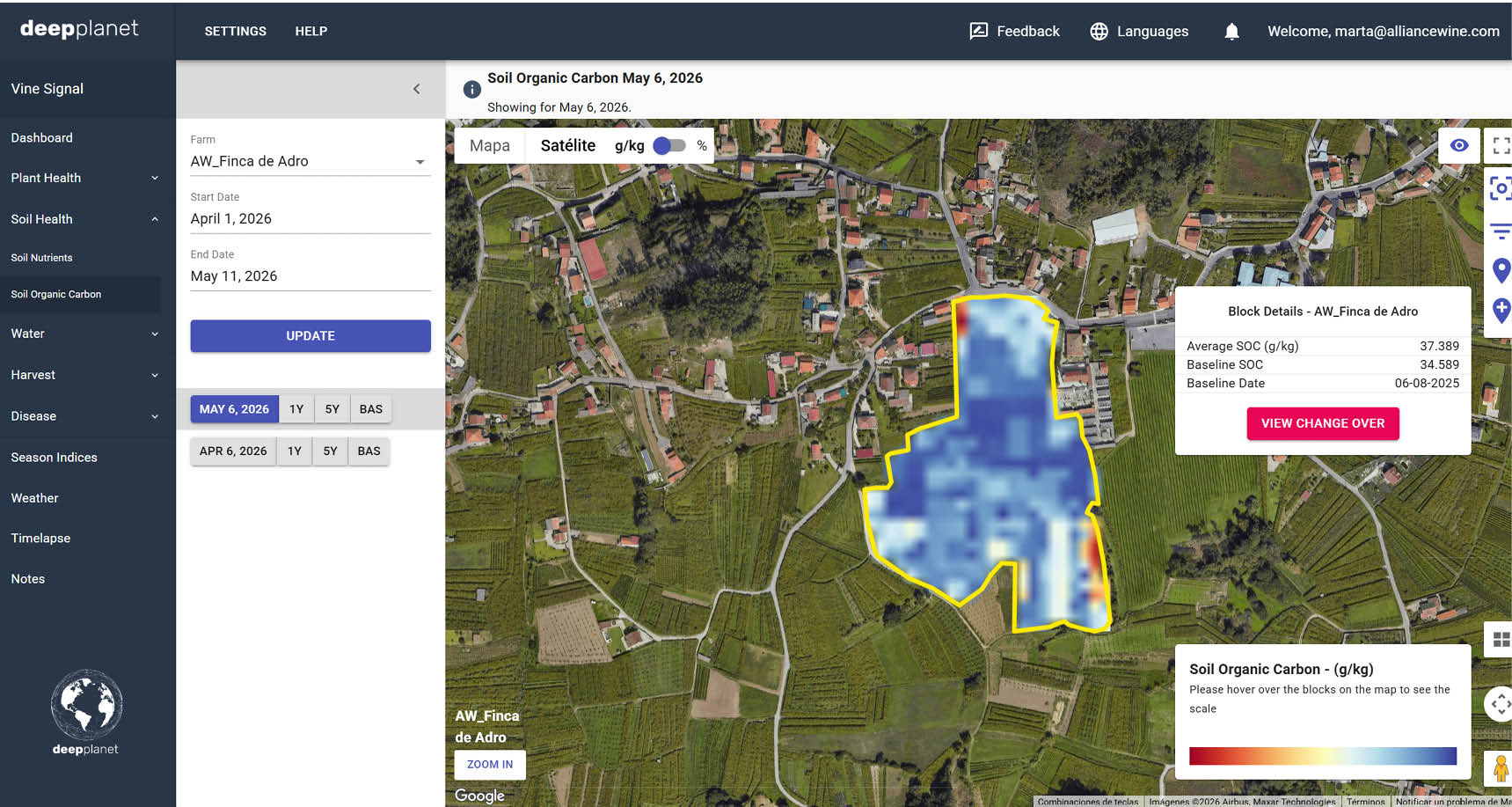
The area we are most excited to share sits not within our own operations but in the vineyards of producers we represent. In 2025, we launched a carbon insetting initiative focused on testing the hypothesis that regenerative practices developed for the specific location will sequester more carbon in the soil.
The distinction from offsetting is intentional - rather than funding carbon projects elsewhere, we wanted to invest in the supply chain we already work within, with producers we already trust.
The producers: what regenerative looks like on the ground

Behind the data are the people and practices that make this project real. Each producer is operating differently, in a different climate, at a different stage of the journey. There is no single template for regenerative viticulture, and through the work we're doing in collaboration with Deep Planet, we’re collating the data that shows the best techniques for different conditions.
Ponte da Boga - Ribeira Sacra, Spain
Altolandon - DO Manchuela, Spain
At the high-altitude organic vineyards of Altolandon, they work with nature rather than against it. They allow plants to establish naturally between vine rows - a living ground cover that protects soil from the sun, prevents erosion, and draws carbon into the ground. In 2025, they also reduced their copper and sulphur treatments, meaning fewer chemical inputs and less disruption to the ecosystem that keeps their soils healthy.
Viña Elena - Jumilla, Murcia, Spain
In the semi-arid region of Jumilla, Viña Elena have replaced their standard sulphur spray programme with a biological fungicide made from potassium bicarbonate, a naturally occurring compound. Unlike sulphur, which can accumulate in soil over time, this natural fungicide protects leaves from disease without disrupting the living ecosystem beneath. Favourable weather meant no sulphur was used at all in 2025 - a step towards chemical independence in one of Spain's most demanding growing environments.
Aquitania, Finca de Adro - Galicia, Spain
Aquitania's most distinctive practice is the use of pheromone dispensers on their Galician Albariño vines - small devices that confuse vine moths' mating signals, causing breeding to collapse naturally without any insecticide. Alongside this, legume cover crops are planted each winter and organic compost applied to build long-term soil health, while copper treatments were reduced to a single application in 2025 - a significant step in a humid region where disease pressure is high.
San Polino - Montalcino, Italy
San Polino have built one of the most comprehensive regenerative programmes in the project across their certified organic Sangiovese slopes outside Montalcino. A 14-species cover crop mix, including wildflowers, legumes, cereals, and grasses, binds the steep terraces against erosion while drawing carbon into the ground. Harvest waste is made into compost, which is returned directly to the soil, and a natural biostimulant supports the vines through summer heat without chemical inputs. Compacted ground has been broken up to allow the soil to breathe, and water channels restored. Luigi and Katia’s belief that healthy soil and great wine are inseparable has led to the creation of this symbiotic system.
Quintas do Homen - Vinho Verde, Portugal
Quintas do Homen have taken meaningful steps towards lighter-touch viticulture across their 13 hectares of vines. In 2025, copper treatments were reduced from three applications to just one, lessening the impact on the soil microorganisms. They also introduced cover crops after harvest for the first time — a legume-based mix that naturally fixes nitrogen in the soil, reducing the need for added fertiliser.
Roebuck's 30 Sussex hectares are managed with a growing commitment to biodiversity, sustainability, and reduced chemical dependency. Each winter, sheep graze the vineyards, naturally fertilising the soil and reducing the need for machinery. Adding natural compost produced from organic waste to the rows, including clippings from pruning and chicken manure, is returning twice as much organic matter to the ground as before. With 40% of all vineyard inputs now natural or organic, Roebuck are quietly but purposefully rewriting how an English vineyard can be managed.
The journey ahead
Looking forward, our priorities are clear: continuing development of the insetting scheme, extending eco-design standards across all packaging on our own production, and deepening engagement with our employees. The work of furthering our decarbonisation plan continues across every part of the business.
Marta Juega Rivera, PhD, says,
“Over the past five years, we have invested heavily in the nature pillar of our Positive Impact Strategy, which wouldn’t exist without the people behind it. In the next year, we are looking to invest further in our social pillars of people and responsible alliances.”
What has changed over the past six years is not the values, but the rigour with which we have applied systems that allow us to measure, report, and improve.
The 2026 Positive Impact Report is a record of progress and an honest account of the further improvements we will undertake in our mission to create a better world of wine.
Written by Kiki Evans, Press, Content and Design Manager, Alliance Wine


